AI Ethics
A curated anthology of the best moments on this topic — drawn from across the full video library, ranked by editorial relevance, with direct links to the exact timestamp in every source session.

Biased AI is not a hypothetical risk — it is already determining who gets hired, housed, and approved for credit. The question is whether the public has the tools to push back.
Watch full session ↗AI Bias Already Shaping Employment, Housing, and Credit Decisions, Researcher WarnsThe debate over whether artificial intelligence poses a future threat misses a more immediate problem: biased algorithms are already making consequential decisions about people's lives across employment, healthcare, housing, college admissions, and credit, with most individuals u
Schmarzo's 'Nano Economics' Framework Builds Individual Predictive Models to Beat the Law of Diminishing ReturnsThe law of diminishing returns — the principle that spending ever more on maintenance, marketing, or care eventually yields less and less improvement — can be circumvented, Schmarzo argues, not by spending more but by abandoning averages entirely. The technique he calls Nano Econ
ChatGPT as Research Assistant, Not Oracle: Schmarzo Urges Socratic Approach to Generative AIThe competitive advantage that once came from memorising and recalling information has been effectively eroded by generative AI tools like ChatGPT, which retrieve definitions, theorems, and synthesis faster than any individual can. Schmarzo's argument is that the human role must
Healthcare Data Corruption Threatens AI Promise, as Hospitals Recode Treatments to Maximise Insurance PayoutsAmerican healthcare has, by Schmarzo's reading, already crossed the tipping point of diminishing returns — spending more while life expectancy in states like Iowa has recently declined — making it among the most promising sectors for AI-driven personalisation of treatment and wel
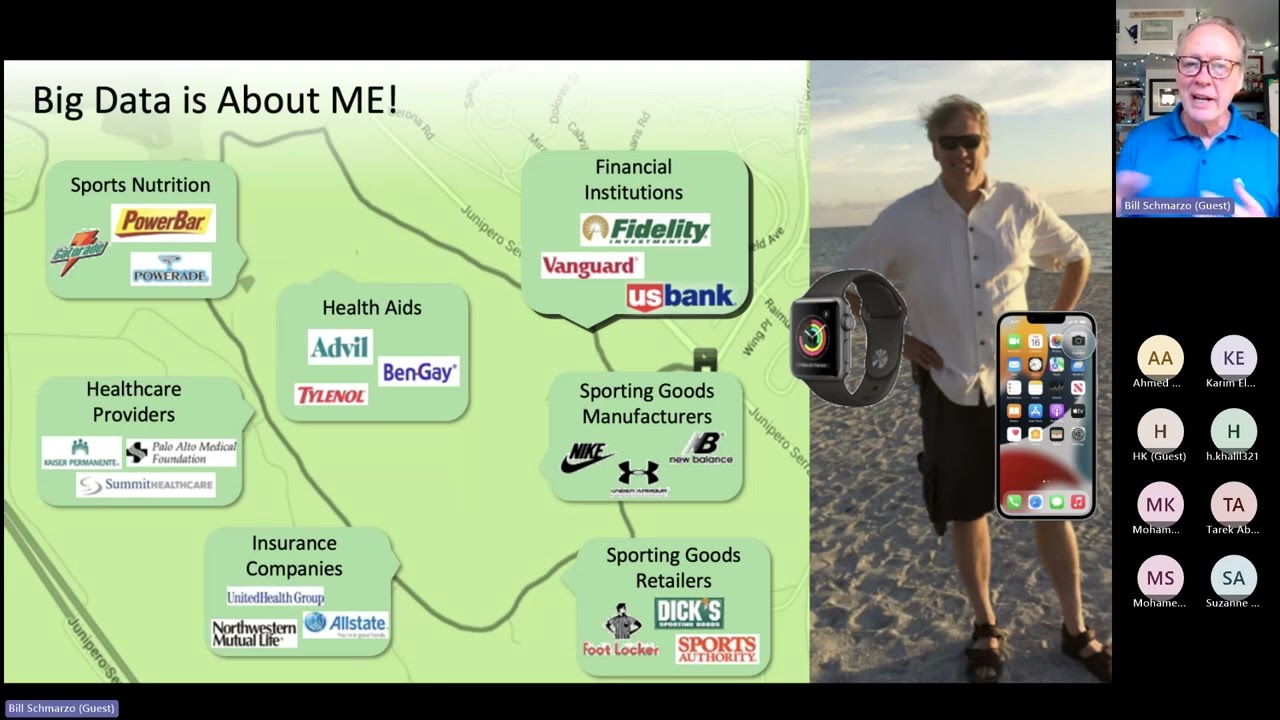
Algorithmic decision-making is already reshaping life chances in employment, lending, and criminal justice — mostly without the knowledge of those affected. The question is whether oversight can catch up before the damage compounds.
Watch full session ↗AI's Benefits Flow Unevenly as Opaque Models Already Shape Hiring, Lending, and JusticeWhat this exposes is not a future risk but a present condition: algorithmic systems — built on incomplete, inaccurate, and structurally biased data — are already determining employment, housing, and criminal justice outcomes for millions of people who neither know they are subjec
If no one's salary depends on an ethical outcome, the ethical commitment is theatre. Schmarzo's argument is that AI bias isn't just a model problem — it's an incentive problem.
Watch full session ↗Ethics Must Be Built Into Compensation Systems, Not Just Mission Statements, Schmarzo ArguesThe structural issue, as Schmarzo frames it, is that organisations routinely profess commitments to diversity, sustainability, and ethical AI while tying no compensation metric to any of them — a contradiction he distils into a maxim borrowed from a former Procter & Gamble CEO: '
Schmarzo Proposes 'Economics of Ethics' Framework to Embed Moral Constraints Directly Into AI ModelsWorking on what he describes as potentially his defining book, Schmarzo is developing a five-stage AI and data literacy framework aimed not at specialists but at high school and middle school students — a deliberate effort to broaden who participates in AI governance. The book's
Big Data's Power Lies in Granularity, Not Volume — and That Distinction Changes EverythingSchmarzo reframes Big Data not as a storage problem but as a resolution problem: where earlier analytics operated at aggregate levels — store sales by week, incidents by month — modern data infrastructure can descend to individual-level behavioural signatures, what he terms 'Nano