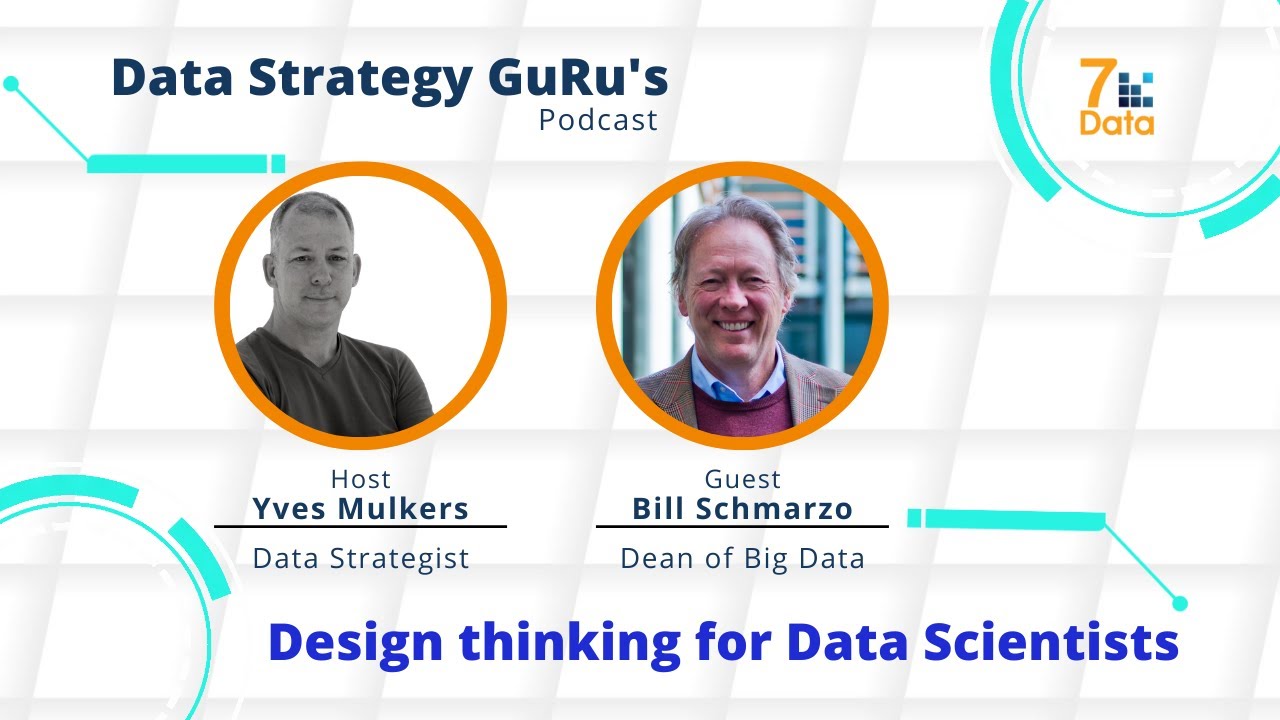
Original source: 7wData
This video from 7wData covered a lot of ground. 7 segments stood out as worth your time. Everything below links directly to the timestamp in the original video.
Most data projects fail before a single query is run. The reason is usually a conversation that never happened about what the organisation is actually trying to achieve.
Data Architecture Debates Are a Distraction, Schmarzo Argues — Start With Value
The instinct to open a data and analytics project by debating data lakes versus data warehouses versus data mesh is precisely backwards, Schmarzo contends. What underpins every failed initiative of this kind — illustrated by a CIO who loaded 35 datasets into a data lake, opened it to business users, and heard nothing but silence — is the absence of a prior answer to a simpler question: how does this organisation actually create value? The choice of repository, he argues, is roughly as consequential as knowing which brand of spark plug sits in one's engine.
What this exposes is a structural misalignment between technical investment and business purpose that compounds across organisations. When architecture precedes strategy, data teams optimise the container before understanding what needs to be stored — and first use cases that could have been launched with three or four datasets instead stall under the weight of 35.
"You can't determine the value of data in isolation of the business."
Profit Is the Wrong KPI, Schmarzo Says — It Measures What Already Happened
Organisations that treat profitability as their primary performance metric are optimising a lag indicator — a measurement of outcomes already locked in — rather than the lead indicators that actually drive long-term health. Employee satisfaction, customer satisfaction, and operational efficiency are the variables that, if improved, produce profit as a downstream consequence. The logical endpoint of profit-first thinking, Schmarzo observes, is firing everyone: labour costs vanish, margins spike, and the company is out of business four months later.
The structural issue here is that most corporate strategy exercises still default to financial targets inherited from mid-twentieth-century management doctrine, leaving organisations without the causal map that would tell them which conditions to cultivate in order to generate the results they actually want.
"I can walk into any company today and increase their profitability over the next three months — guaranteed. You know how I do that? I fire everybody."
Customer Journey Mapping Unlocks AI's Limits — and Reveals Where Humans Must Lead
Customer journey mapping — the practice of tracing every decision and action a person takes while pursuing a specific outcome, whether buying a house or repairing industrial equipment — functions as a diagnostic tool for identifying where algorithms can optimise and, critically, where they cannot. AI can accelerate individual steps in a journey; it cannot observe that two of those steps are unnecessary in the first place. That second insight, Schmarzo argues, belongs exclusively to the frontline human who can say: if I had this information earlier, I would not need to do those steps at all.
The real question is not whether AI can optimise processes but whether organisations are willing to empower the people closest to those processes to reinvent them — a distinction that separates incremental efficiency gains from structural transformation.
"If you empower the human, you can go beyond optimization to reinvention."
AI's Ceiling Is Set by Human Intuition, Not Algorithmic Power
Feature engineering — the act of selecting which variables an AI model should pay attention to — is not a data scientist's task, Schmarzo argues; it belongs to the frontline employee whose daily proximity to operations and customers generates intuitions that no amount of compute can replicate. The point is illustrated through Alan Turing's work breaking the Enigma cipher: Turing's machine could not learn fast enough until a clerical worker intercepting Nazi messages noticed that one operator consistently opened transmissions with what appeared to be a girlfriend's name, giving Turing a fixed starting point and, combined with the known closing phrase of every message, the foothold needed to train the machine.
The parallel is direct: the knowledge that collapses an intractable search space rarely originates in the executive suite or the data lab — it surfaces from the people who handle the raw material every day.
"Our ability to ultimately be successful with AI is entirely human dependent."
Conflicting KPIs Are Not a Problem to Resolve — They Are Where AI Creates Value
The conventional instinct when stakeholders produce incompatible performance metrics is to negotiate them down to a manageable few, letting the loudest voice in the room set the frame. Schmarzo inverts this: it is precisely the tension among thirty or forty misaligned KPIs — retain the most valuable customers while also achieving this and that — that creates the conditions in which AI generates innovation rather than mere optimisation. Three aligned metrics can be solved with a spreadsheet; a cascading, conflicting set of objectives requires a system that can test continuously against real-world feedback.
What this exposes is that organisations which suppress metric diversity in the name of clarity are simultaneously suppressing the complexity that makes advanced AI worthwhile.
"That conflict is where the innovation happens."
The Best Data Strategist Understands Economics and Design Thinking — Not Algorithms
Drawing on the NBA concept of the two-way player — effective on both offence and defence — Schmarzo defines the exceptional data strategist as someone who combines an economics grounding, which orients thinking toward value creation, with design thinking fluency, which orients it toward human empowerment. The ability to write a machine learning algorithm is explicitly not on the list; that skill is widely available and increasingly commoditised. What remains scarce is the capacity to drive cultural transformation alongside technical deployment.
The structural issue this reflects is visible in most data strategy job postings, which lead with SQL and Python requirements while omitting any mention of business value creation — hiring for the tool while leaving the purpose undefined.
"I didn't say anything at all about needing to know how to write a machine learning algorithm."
'Data-Driven' Is Not Enough — Schmarzo Calls for 'Value-Driven Using Data'
Being data-driven, as an organisational aspiration, is structurally incomplete: it specifies an input without naming an outcome. Schmarzo's reframe — value-driven using data — shifts the frame from the instrument to the purpose, grounding the exercise in economics, which he defines as the creation and distribution of value. The practical consequence is a different first question: not 'what does the data show?' but 'what decision are we trying to make better, and for whom?'
The distinction reflects a pattern in which organisations invest heavily in data infrastructure while remaining unable to articulate what improved decisions would look like — a gap that compounds over time as capability outpaces clarity of intent.
"We don't want to be data driven — we want to be value driven using data."
Summarised from 7wData · 39:57. All credit belongs to the original creators. Streamed.News summarises publicly available video content.